Manufacturer fit is broader than whether a factory can make a product sample. Buyers should test whether the supplier understands the specification, can support the required configuration and quantity, provides comparable commercial terms, controls production changes, and can meet the route to delivery. A staged screen from quotation to shipment makes gaps visible before deposits and production commitments become difficult to unwind.
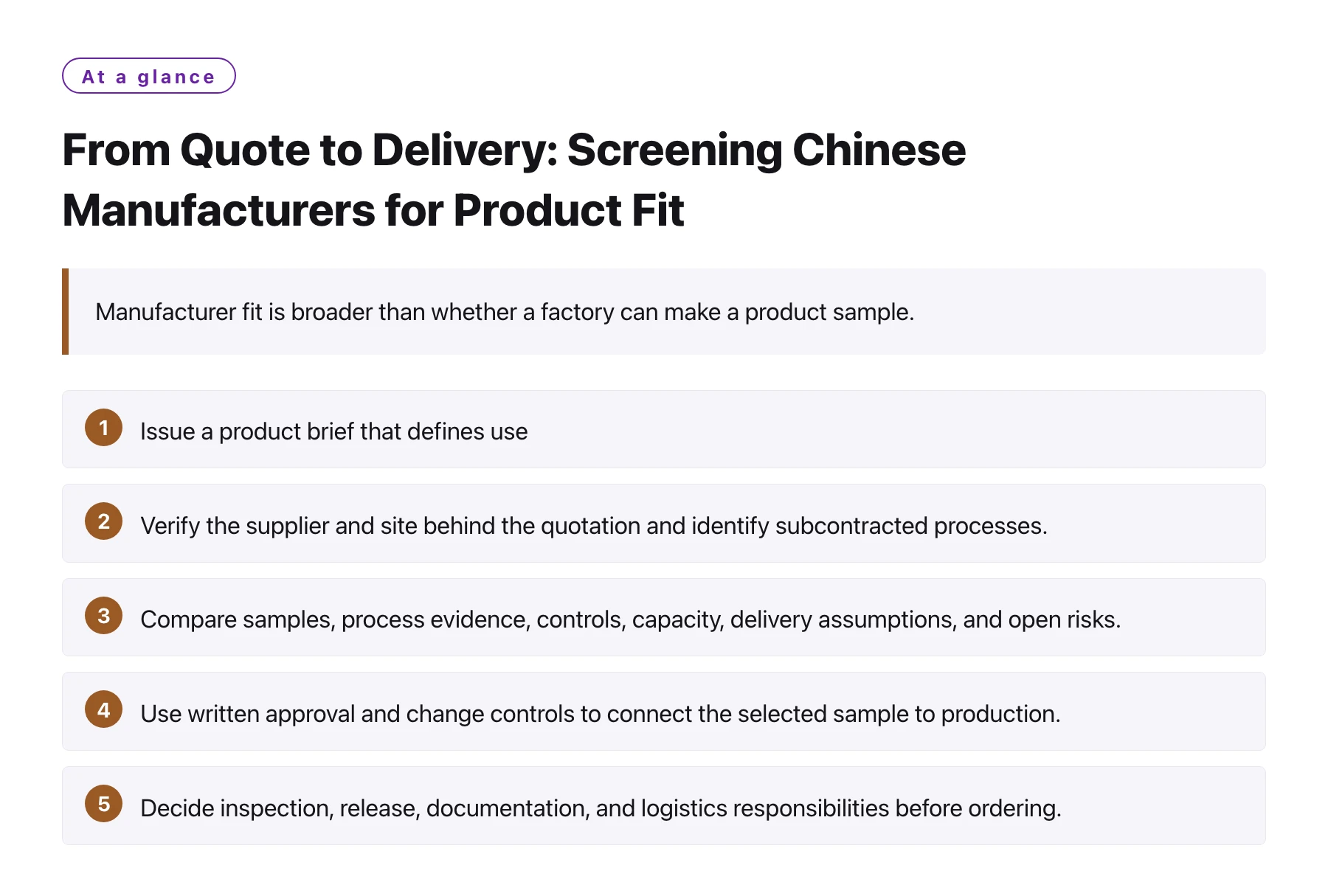
Key takeawaysIssue a product brief that defines use, market, configuration, quantity, quality, and timing. · Verify the supplier and site behind the quotation and identify subcontracted processes. · Compare samples, process evidence, controls, capacity, delivery assumptions, and open risks. · Use written approval and change controls to connect the selected sample to production. · Decide inspection, release, documentation, and logistics responsibilities before ordering.
A good screen narrows the questions at each stage instead of collecting documents without a decision purpose.
Stage 1: Define the selection brief
Describe product use, destination market, model variants, materials, dimensions, critical functions, packaging, order quantity, and target arrival date. Separate non-negotiable requirements from preferences and questions still under design. Suppliers cannot be compared fairly if each is asked to price a different interpretation. Identify who can clarify technical issues and who can approve a deviation.
State the evidence needed with the offer: manufacturer and production site, product drawings, bill of materials, sample availability, test or compliance records, process description, capacity assumptions, packaging, and delivery plan. The evidence should match the decision. For instance, a supplier profile may help establish identity, while a production sample is needed to examine the offered configuration.
Buyers can Learn more about supplier sourcing support as they organize candidate outreach. Regardless of channel, retain the exact brief and response set so later changes to model, quantity, destination, or date can be checked against the original assumptions.
Stage 2: Identify the contracting and production parties
Record the business entity responding to the quote, the seller named in the proposed contract, the factory site, and the party receiving payment. Ask whether the respondent is a manufacturer, trading company, distributor, or agent and what role each party performs. The distinction can affect production access, intellectual property, warranty responsibility, change approval, and who will resolve defects.
Request a site address and a clear explanation of any subcontracted steps. Map which party performs fabrication, assembly, surface finishing, testing, packing, or export handling. Ask who controls supplier changes and how the buyer will be informed if a process moves to a different site. A factory visit or online profile supports specific verification but does not establish every capability.
Check names and addresses across quotation, licenses, certificates, bank instructions, and proposed purchase documents. Inconsistencies may be explainable, but they should be resolved before payment. Verify changed bank details through a known contact path and involve the buyer’s finance controls.
Stage 3: Compare the quotation assumptions
Normalize every offer to model revision, material, components, accessories, color mix, order quantity, packaging, inspection, delivery point, and requested date. Ask suppliers to separate unit price from tooling, sample charges, tests, inspection, spare parts, packaging, and freight. List alternate configurations separately and require an explanation of their effect on performance, evidence, appearance, and timing.
Read exclusions and validity. Confirm currency, minimum quantities, tier pricing, payment milestones, deposit conditions, production lead time, warranty, and who pays for changes. A quote may omit a required test, replacement part, inspection, or destination service. Add those items to the comparison before describing one proposal as cheaper.
Check that delivery terms identify an exact named place and applicable rule. Clarify who books transport, manages export clearance, buys insurance, clears import, and delivers to the final location. Make sure logistics estimates are based on actual package dimensions and weights rather than an assumed carton configuration.
Stage 4: Test the sample against the offer
Ask for a sample that represents the quoted model and record its identifier, date, materials, components, revision, and any temporary substitutions. Compare it with the brief using the same criteria across candidates. Check dimensions, interfaces, function, finish, accessories, labels, assembly, and packaging as relevant to the product. Photograph details and record open items rather than relying on general impressions.
Separate attributes that a sample can demonstrate from those that need other evidence. One sample may help judge fit and finish but cannot prove production consistency, available capacity, every compliance requirement, or shipment condition. Request test results, manufacturing records, or process evidence for claims that are not observable from the sample.
When the sample is revised, preserve both versions and the decision history. Name the reviewer and scope of acceptance. “Approved” should identify which model and attributes are accepted and any condition that must be closed before production. Obtain a production representative sample where an early prototype differs materially from the commercial offer.
Stage 5: Review production and quality controls
Ask how the supplier controls incoming components, work instructions, inspections, traceability, nonconforming product, and corrective actions for this model. A management-system certificate can describe a quality framework for a defined scope, but it does not establish that the particular product meets the buyer’s requirements. The International Organization for Standardization describes ISO 9001 as a quality-management-system standard; assess the certificate’s scope separately from product-specific evidence. [1]
Confirm that the factory can identify the approved drawing, sample, and revision at the workstations. Require written notice and approval for changes to material, component, process, factory, subcontractor, packaging, or test method where those changes could affect the agreed result. Decide who is authorized to approve a deviation and how the decision reaches purchasing, production, and inspection.
Set inspection timing, scope, sample method, acceptance criteria, report format, and release authority before the order starts. Identify which checks can be done by the buyer, supplier, or independent party and which need laboratory or specialist review. Clarify how a failed check leads to containment, rework, additional evidence, or re-inspection.
Stage 6: Check capacity and delivery realism
Ask how the proposed production schedule relates to the requested configuration and quantity. Identify long-lead materials, production-line constraints, subcontractors, seasonal demand, and buyer approvals that affect the calendar. Request milestone dates for materials, production, inspection, packing, and dispatch rather than relying on one broad lead-time estimate.
Ask when capacity is reserved and how the supplier will report a delay. Determine whether the order can be produced in phases, whether partial delivery is acceptable, and how the factory will protect consistency across lots. If timing depends on sample, artwork, or technical approval, set a latest decision date and show its effect on the schedule.
Check that the packaging and loading plan suits the route, storage, and receiving location. Confirm carton or bundle dimensions, weight, handling requirements, labels, and delivery booking. The supplier’s delivery promise should reflect the actual handoff point and commercial term, not an undefined “arrival” date.
Stage 7: Evaluate communication through real work
Use the screening process itself to observe completeness and clarity. Does the supplier answer the question asked, identify assumptions, provide model-specific documents, and escalate issues? Does the production contact understand the technical brief, or do messages stop at sales? Keep the assessment based on documented interactions rather than fluency or presentation alone.
Agree a named contact for technical questions, schedule updates, quality findings, and commercial changes. Define how urgent issues are escalated across time zones and how decisions are recorded. Ask who can authorize production changes, concessions, and shipment release. A responsive supplier still needs an accountable communication path.
Test how the supplier handles a hypothetical discrepancy: a component is unavailable, a sample has a fit issue, or the shipment date slips. Look for a clear explanation, options, evidence, and request for approval. A willingness to surface a problem early is more useful than an unsupported promise that no problems will occur.
Stage 8: Make a documented selection decision
Use a comparison matrix with mandatory requirements, evidence received, sample result, capability, quality controls, capacity, communication, price, delivery, and unresolved risk. Mark each item accepted, not applicable, failed, or open, and identify the reviewer. A weighted score can help compare qualified candidates but should not override a mandatory gap or missing market approval.
Choose the next action for each candidate: decline, request clarification, obtain a revised sample, conduct a process review, negotiate, or approve for a controlled first order. For conditional approval, state the conditions, evidence, owner, due date, and what cannot begin until the condition closes. Keep the decision tied to the product and order under review.
After the order, compare actual production, inspection, schedule, documents, and delivery with the screening assumptions. Record performance by model, site, and lot. Use the feedback to refine the brief and qualification process; do not treat one successful sample or shipment as proof that every future order is assured.
Sources
Frequently asked questions
What is the first step in screening a manufacturer?
Create a comparable brief with the model, intended use, destination market, order quantity, quality needs, evidence requested, schedule, and decision owner.
Can a sample prove a manufacturer is a good fit?
A sample supports review of one configuration. Also assess site identity, production controls, capacity, documentation, commercial assumptions, and delivery readiness.
Does a supplier certificate prove product compliance?
Not by itself. Check its scope, issuer, dates, and covered site, then review product-specific evidence and market requirements with qualified owners.
When should a buyer commit to production?
Commit after the specification, sample decision, quotation assumptions, required evidence, change rules, inspection method, shipment duties, and approval owners are documented.