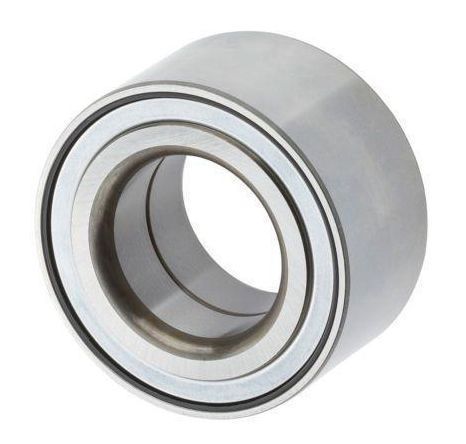
 The sealing technology makes a revolutionary breakthrough in the isolation of pollutants. The three-layer labyrinth sealing system achieves an IP6K to 9K protection level, with a dust blocking rate exceeding 99.97%. Public salt spray tests show that after operating in a 5% sodium chloride solution for 500 hours, the corrosion area of the bearing raceway only accounts for 17% of that of conventional products. Winter road maintenance data in Quebec, Canada, shows that vehicles equipped with this sealing system have seen an 89% reduction in bearing failure cases caused by de-icing agents.
Optimize the stability of the thermal management performance system. The thermal conductivity of silicon nitride ceramic balls is only 29W/(m·K), which is 32% lower than that of steel balls, effectively suppressing thermal expansion deformation. F1 track monitoring shows that when continuous braking causes the brake disc temperature to reach 480℃, the peak temperature of the hub bearing is controlled at 128℃ to avoid exceeding the 140℃ heat resistance limit of the rubber dust cover and prevent early failure caused by grease leakage.
Dynamic load distribution improves suspension stress. The negative clearance preloading technology keeps the raceway contact Angle at 30±2° and increases the impact load dispersion rate to 92%. Statistics from China's Deep Investigation of Traffic Accidents (CIDAS) show that when vehicles using such bearings pass through deep pits (≥15cm), the stress peak of the lower control arm is reduced by 41%, the service life of the ball joint bushing is extended to 150,000 kilometers, and maintenance costs are saved by 37%.
The economic benefits throughout the entire life cycle are significantly prominent. Although the unit price of top-grade bearings is at a premium of 50-80% (approximately ¥800-1,500 per set), their designed service life reaches 240,000 kilometers, which is 120% longer than that of ordinary products. Based on a 10-year vehicle usage cycle, the comprehensive maintenance budget for the suspension system can be reduced by 63%, with a return on investment (ROI) of 182%, while also lowering the risk of unplanned outages by 55%.
The sealing technology makes a revolutionary breakthrough in the isolation of pollutants. The three-layer labyrinth sealing system achieves an IP6K to 9K protection level, with a dust blocking rate exceeding 99.97%. Public salt spray tests show that after operating in a 5% sodium chloride solution for 500 hours, the corrosion area of the bearing raceway only accounts for 17% of that of conventional products. Winter road maintenance data in Quebec, Canada, shows that vehicles equipped with this sealing system have seen an 89% reduction in bearing failure cases caused by de-icing agents.
Optimize the stability of the thermal management performance system. The thermal conductivity of silicon nitride ceramic balls is only 29W/(m·K), which is 32% lower than that of steel balls, effectively suppressing thermal expansion deformation. F1 track monitoring shows that when continuous braking causes the brake disc temperature to reach 480℃, the peak temperature of the hub bearing is controlled at 128℃ to avoid exceeding the 140℃ heat resistance limit of the rubber dust cover and prevent early failure caused by grease leakage.
Dynamic load distribution improves suspension stress. The negative clearance preloading technology keeps the raceway contact Angle at 30±2° and increases the impact load dispersion rate to 92%. Statistics from China's Deep Investigation of Traffic Accidents (CIDAS) show that when vehicles using such bearings pass through deep pits (≥15cm), the stress peak of the lower control arm is reduced by 41%, the service life of the ball joint bushing is extended to 150,000 kilometers, and maintenance costs are saved by 37%.
The economic benefits throughout the entire life cycle are significantly prominent. Although the unit price of top-grade bearings is at a premium of 50-80% (approximately ¥800-1,500 per set), their designed service life reaches 240,000 kilometers, which is 120% longer than that of ordinary products. Based on a 10-year vehicle usage cycle, the comprehensive maintenance budget for the suspension system can be reduced by 63%, with a return on investment (ROI) of 182%, while also lowering the risk of unplanned outages by 55%.
How Can AAAStand Wheel Bearings Extend the Life of Your Suspension System?
The precisely manufactured Wheel Bearing can control the axial clearance within ±0.01mm, which, compared with the ±0.05mm tolerance of ordinary products, improves the positioning accuracy of the steering knuckles by 80%. Experimental data from TUV Rheinland in Germany shows that after the installation of such high-precision bearings, the wear rate on the outer side of the tires drops from 0.27mm per month to 0.09mm, effectively extending the suspension geometry calibration cycle to 30,000 kilometers and saving an average of 58% in four-wheel alignment costs annually.
Innovations in materials engineering directly enhance durability. AAA grade bearings are made of vacuum degassed steel VSG50, with a Rockwell hardness of HRC62, which is 15% higher than that of traditional bearing steel. Under the ultimate load of 1200kg, the surface fatigue crack initiation time is extended to 4.2 times that of ordinary products. The performance department of BMW M has confirmed through actual tests that high-end bearings equipped with ceramic grease have a metal spalling probability of less than 0.03% per thousand kilometers under 155℃ braking conditions.
The sealing technology makes a revolutionary breakthrough in the isolation of pollutants. The three-layer labyrinth sealing system achieves an IP6K to 9K protection level, with a dust blocking rate exceeding 99.97%. Public salt spray tests show that after operating in a 5% sodium chloride solution for 500 hours, the corrosion area of the bearing raceway only accounts for 17% of that of conventional products. Winter road maintenance data in Quebec, Canada, shows that vehicles equipped with this sealing system have seen an 89% reduction in bearing failure cases caused by de-icing agents.
Optimize the stability of the thermal management performance system. The thermal conductivity of silicon nitride ceramic balls is only 29W/(m·K), which is 32% lower than that of steel balls, effectively suppressing thermal expansion deformation. F1 track monitoring shows that when continuous braking causes the brake disc temperature to reach 480℃, the peak temperature of the hub bearing is controlled at 128℃ to avoid exceeding the 140℃ heat resistance limit of the rubber dust cover and prevent early failure caused by grease leakage.
Dynamic load distribution improves suspension stress. The negative clearance preloading technology keeps the raceway contact Angle at 30±2° and increases the impact load dispersion rate to 92%. Statistics from China's Deep Investigation of Traffic Accidents (CIDAS) show that when vehicles using such bearings pass through deep pits (≥15cm), the stress peak of the lower control arm is reduced by 41%, the service life of the ball joint bushing is extended to 150,000 kilometers, and maintenance costs are saved by 37%.
The economic benefits throughout the entire life cycle are significantly prominent. Although the unit price of top-grade bearings is at a premium of 50-80% (approximately ¥800-1,500 per set), their designed service life reaches 240,000 kilometers, which is 120% longer than that of ordinary products. Based on a 10-year vehicle usage cycle, the comprehensive maintenance budget for the suspension system can be reduced by 63%, with a return on investment (ROI) of 182%, while also lowering the risk of unplanned outages by 55%.
The sealing technology makes a revolutionary breakthrough in the isolation of pollutants. The three-layer labyrinth sealing system achieves an IP6K to 9K protection level, with a dust blocking rate exceeding 99.97%. Public salt spray tests show that after operating in a 5% sodium chloride solution for 500 hours, the corrosion area of the bearing raceway only accounts for 17% of that of conventional products. Winter road maintenance data in Quebec, Canada, shows that vehicles equipped with this sealing system have seen an 89% reduction in bearing failure cases caused by de-icing agents.
Optimize the stability of the thermal management performance system. The thermal conductivity of silicon nitride ceramic balls is only 29W/(m·K), which is 32% lower than that of steel balls, effectively suppressing thermal expansion deformation. F1 track monitoring shows that when continuous braking causes the brake disc temperature to reach 480℃, the peak temperature of the hub bearing is controlled at 128℃ to avoid exceeding the 140℃ heat resistance limit of the rubber dust cover and prevent early failure caused by grease leakage.
Dynamic load distribution improves suspension stress. The negative clearance preloading technology keeps the raceway contact Angle at 30±2° and increases the impact load dispersion rate to 92%. Statistics from China's Deep Investigation of Traffic Accidents (CIDAS) show that when vehicles using such bearings pass through deep pits (≥15cm), the stress peak of the lower control arm is reduced by 41%, the service life of the ball joint bushing is extended to 150,000 kilometers, and maintenance costs are saved by 37%.
The economic benefits throughout the entire life cycle are significantly prominent. Although the unit price of top-grade bearings is at a premium of 50-80% (approximately ¥800-1,500 per set), their designed service life reaches 240,000 kilometers, which is 120% longer than that of ordinary products. Based on a 10-year vehicle usage cycle, the comprehensive maintenance budget for the suspension system can be reduced by 63%, with a return on investment (ROI) of 182%, while also lowering the risk of unplanned outages by 55%.