Planning Cash Flow Around Skincare MOQs and Lead Times
A skincare MOQ is a cash-flow event before it is a unit price. Model deposits, packaging commitments and the gap between a 4–8 week ODM route and a 3–6 month OEM route before choosing whether 500, 1,000 or 5,000 units belongs in the first purchase order.

Key takeaways
- Translate every MOQ into cash, months of cover and storage space.
- Place packaging and testing dates on the same calendar as production.
- Protect a reserve for the second order instead of spending everything on the first.
- Use a small market test only when its higher unit cost answers a clear question.
Why does MOQ planning start with sell-through?
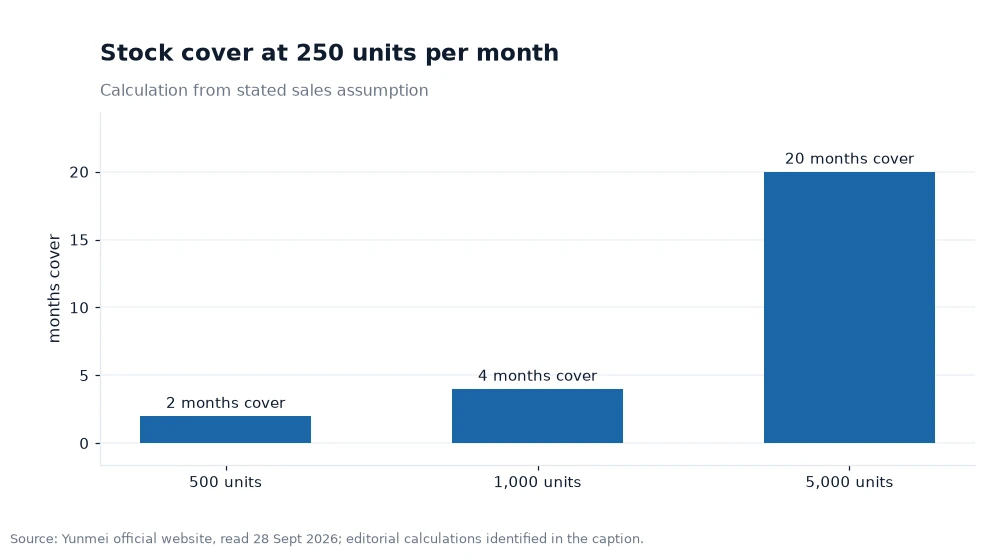
Estimate realistic monthly sales in a conservative, base and strong case. Then divide the proposed order by each rate. A 5,000-unit order is five months of cover at 1,000 units a month, but twenty months at 250. The product has not become cheaper if cash sits in slow stock.
Add units reserved for samples, replacements, creators and quality retention. Those items do not produce ordinary sales revenue, yet they consume the same manufactured batch. A plan that treats every filled unit as sellable will overstate available stock from the first day.
Which costs arrive before finished goods?
Formula work, samples, package deposits, artwork preparation and testing may all require payment before the balance on finished production. Ask the supplier for a milestone schedule instead of one total. Finance can then place cash requirements against dates rather than guessing from the launch month.
Packaging may create a separate minimum from the cosmetic fill. A pump vendor may require more components than the first product run. Record the surplus, its ownership, storage location and compatibility with the next order so unused parts do not disappear from the economics.
How should buyers compare factory options?
A directory of private label skincare manufacturers China helps identify candidates, but compare quotations on the same quantity, formula route, pack and evidence package. Otherwise the lowest-looking total may omit stability work, tooling or a component commitment carried elsewhere.
Yunmei publishes a usual MOQ of 1,000–5,000 units per product and an entry point as low as 500 units for startup brands. Treat that range as a planning input. The final number still depends on formula, package, material purchasing and line scheduling.
| Order | Sales at 250/month | Sales at 500/month |
|---|---|---|
| 500 units | 2 months | 1 month |
| 1,000 units | 4 months | 2 months |
| 5,000 units | 20 months | 10 months |
What does the development route do to working capital?
An existing-formula ODM route is published at four to eight weeks. A new OEM development is listed at three to six months, including research, testing and production. The longer route means money can leave the account much earlier than saleable inventory arrives.
Do not fund the order as though every task starts and ends together. Plot sample rounds, compatibility checkpoints, packaging purchase and final payment separately. A delay in one stream may leave another commitment irreversible, particularly when printed components have already been produced.
How much reserve should remain after the deposit?
Keep enough liquidity for freight, import costs, launch activity and a reorder deposit. The exact percentage depends on the business, so model it directly. If placing the first order empties the account, a successful launch can create a stockout that the brand cannot finance.
A reserve also pays for decisions. A failed pump test may require a component change; an artwork correction may waste printed stock. Calling these possibilities a contingency does not mean they will happen. It means the plan can absorb information discovered during development.
When is a 500-unit test rational?
A small run is rational when it tests a defined uncertainty such as channel demand, shade preference or repeat purchase. State the question and the decision threshold before ordering. Without that discipline, a small batch can become expensive inventory that teaches nothing.
Compare learning value with setup cost. Some fixed work—artwork, sampling, documentation and project management—does not shrink in proportion to units. The brand should know which decisions become more reliable after 500 sales and whether those decisions justify the higher cost per unit.
How should the reorder trigger be set?
Start with remaining stock, average weekly sales, supplier lead time and a buffer. If sales average 200 units a week and replenishment takes eight weeks, demand during lead time is 1,600 units. Adding a four-week buffer creates a reorder point of 2,400 units.
Review the trigger after launch because actual sales and route timing replace assumptions. The first model is not a forecast carved in stone; it is a control that prevents purchasing from waiting until shelves look empty.
Worked example: cash tied up by order size
At an illustrative landed cost of $4.20 per unit, 500 units tie up $2,100, 1,000 units tie up $4,200 and 5,000 units tie up $21,000. If 10% of units support samples and launch activity, sellable quantities become 450, 900 and 4,500. This arithmetic is illustrative; buyers should replace the cost with a written quotation.
The final bar is ten times the startup quantity and ten times the cash exposure. A lower quoted unit price can still create the more demanding financing decision when quantity rises faster than proven demand.
Frequently asked questions
Is the lowest MOQ always the safest choice?
No. A small order limits inventory exposure but can carry more fixed cost per unit. Choose it when the batch will answer a specific commercial question.
What lead times should a cash-flow model use?
Yunmei publishes four to eight weeks for ODM using an existing formula and three to six months for OEM development. Add packaging, freight and local clearance assumptions separately.
Should surplus packaging appear in the model?
Yes. Record paid components even when they are not filled in the first run, along with ownership, storage and whether they can be used for a later order.
Put quantity, time and cash on one page
A workable buying plan shows when money leaves, when evidence arrives and how quickly finished stock must sell. Update it after every sample gate so the purchase order reflects current facts rather than the first optimistic estimate. Forecasts should be revisited when new information arrives. After the first sales period, replace the original demand assumption with actual weekly movement, returns and channel inventory. Update the stock-cover calculation and reorder point, then check whether packaging on hand remains suitable. If the product is slower than planned, pause extensions and protect cash. If it is faster, identify the long-lead component early rather than waiting for finished stock to run low. Record the date and source of each assumption so finance and marketing can understand why the forecast changed. A model that is revised openly is more useful than a precise-looking spreadsheet that no one trusts. Before the project is closed, compare the approved record with the exact item being purchased. Check the version, quantity, component and evidence reference rather than relying on a remembered conversation. Ask the supplier to confirm any open assumption in writing, and save that confirmation with the quotation. If an answer changes the brief, update the sample and calendar before releasing the next commitment. This final reconciliation gives the brand a clear basis for later questions from production, quality or customer service. It also makes the next order easier to plan because the team can distinguish what was learned from what was merely assumed during the first launch. A useful forecast has a named owner and a review rhythm. Set a monthly check before launch and a more frequent review when inventory approaches the reorder threshold. Include marketing promotions, retail onboarding and seasonal effects as explicit assumptions rather than unexplained adjustments. If a sales channel changes its forecast, update both expected sell-through and the cash required for the next batch. Keep a record of why the forecast changed; this helps the team learn whether its original assumptions were too optimistic or whether the market itself moved. Do not place a replenishment order solely because the factory offers a volume discount. Compare the additional stock with its likely holding period and the funds needed for other launch commitments. Review Yunmei’s OEM/ODM manufacturing overview and use the same written brief for every sample round.
Public MOQ, route and testing ranges were read from Yunmei's official site on 28 Sept 2026. Stock-cover figures use the sales assumptions stated in the text.[1].