Sample Retention: Traceability Years Later
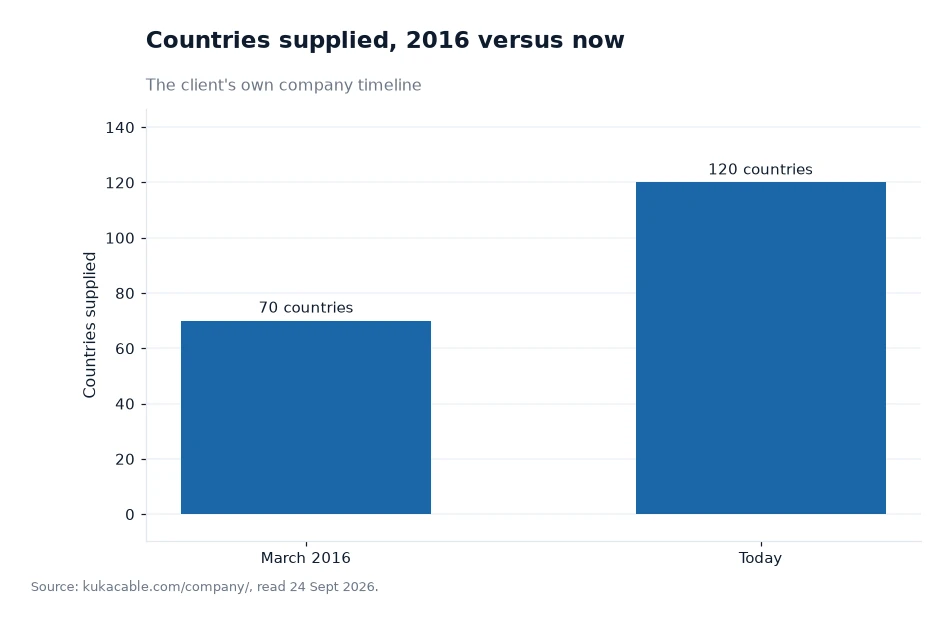
When a claim arrives three years after a delivery, the useful object is not the invoice, it is the length of cable kept from the same production batch. Sample retention with traceability is one of the four stages the manufacturer publishes under its SIF quality model, alongside 100% inspection of finished products. The same company timeline records supplies to over 70 countries in March 2016 and to more than 120 countries today.
Key takeaways
- Sample retention and traceability is published as the fourth stage of the manufacturer's SIF quality model.
- The same model starts with raw materials tested against several international benchmarks and ends with 100% inspection of finished products.
- Published reach is more than 120 countries today, against over 70 countries recorded in March 2016 on the company timeline.
- The site publishes no retention period in years, so the length of storage has to be agreed with the supplier in the contract.
What a retained sample is expected to settle
A dispute about a cable usually turns on one question: was the cable that failed the cable that was shipped? A retained sample from the same batch answers it by making a physical comparison possible. The sample can be measured, stripped, cut and tested long after the batch has left the factory, and the result can be compared with the values recorded when the batch was made. KUKA CABLE publishes that stage as part of a named quality model rather than describing it informally, which means a buyer can point to it in a contract and ask for it to appear in the order confirmation.
Retention applies across the range the company makes, and for solar cables it is the only practical way to compare a length that has been in service with the batch that produced it. The published SIF model pairs sample retention with traceability, which is the record that connects a reel to a production date, a compound lot and a test result. Without that record the retained length is just cable on a shelf.
Where retention sits in the quality model
The four stages are published in sequence. First, raw materials are selected and tested against several international benchmarks. Second, manufacturing is monitored by digital control systems rather than by inspection at the end. Third, finished products go through 100% inspection for electrical, mechanical and environmental performance. Fourth, samples are retained with their traceability records.
- Raw material: compound and copper checked against multiple benchmarks before extrusion.
- Production: dimensions and process data monitored as the cable runs.
- Finished cable: every length inspected, including the 10 kV spark test during production.
- After shipment: retained samples and records that can be recalled years later.
Each stage produces documents, and those documents are what a buyer can request. A quotation that offers only a certificate number gives no route back to a batch, while a supplier working this way can name the date, the lot and the test results behind a specific reel. The standards behind the delivered cable are TUV 2PfG 1169/08.2007, EN 50618:2014 and IEC 62930 for the PV family, and the certificates page counts more than 30 certificate types such as TUV, IEC, CE, SAA and UL.
Traceability across a widening customer map
Traceability gets harder as the customer map grows, and the company timeline records that growth. The site dates the founding to August 2012 and the first factory to December 2012, notes supplies to over 70 countries by March 2016, and states that products and services now reach customers in more than 120 countries. Warehouses and offices are published in the UK, Spain, Indonesia and Australia, with a head office in Shanghai.
Those locations matter to a claim. If a replacement length is needed quickly, a locally held stock position shortens the route, and a question about a batch can be answered from the same region where the cable was delivered. The manufacturer's published reasoning for the overseas footprint is the one-stop butler service, where one product consultant follows the enquiry, the delivery and the after-sales question.
Where samples are kept and why the map helps
| Published site | Location in the published text | What it supports |
|---|---|---|
| United Kingdom warehouse | Blackley, Manchester | Local delivery and returns for UK projects |
| Spain warehouse | Av. de La Rioja 1, Entreplanta, 26001 Logroño, La Rioja | Southern European deliveries |
| Shanghai head office | Building 15, No. 9655 Tingwei Highway, Tinglin Town, Jinshan District | Production, laboratory and batch records |
| Indonesia office and warehouse | Tangerang | South-east Asian deliveries |
| Australia office and warehouse | QLD, VIC, NSW, WA and SA | Coverage across five Australian states |
The Shanghai entry is the one that holds the record trail: the speciality cable laboratory established in December 2015 and described as an ISO/IEC 17025 facility sits in Jinshan District, in a facility published as covering more than 7,000 m², and it is where a returned length would be examined. A question raised in Australia or Spain can therefore be routed to the same production records without the cable travelling back to China first, which shortens the interval between a claim and an answer.
Worked example
The timeline gives two country counts. Over 70 countries by March 2016 and more than 120 today. The difference is at least 50 countries, and the interval from March 2016 to the read date of this article in September 2026 is about 10.5 years, which gives an average of roughly 5 new countries a year. Both the subtraction and the division are the author's own arithmetic on published figures, and they are averages rather than annual results.
Apply the same reading to retention. If a claim arrives five years after a delivery, the batch record has to survive five years of movements, relocations and staff changes to be useful. Ask the supplier how long samples are held as a matter of routine, because the site does not publish a retention period in years, and then write the agreed period into the order.
Frequently asked questions
How long does the manufacturer keep samples of a delivered batch?
The site does not publish a retention period in years. What it does publish is sample retention and traceability as the fourth stage of its SIF quality model, together with 100% inspection of finished products. A buyer who needs a defined retention period should agree it in the contract and ask for it to appear in the order confirmation.
What is needed for traceability to work in practice?
A retained sample needs to be tied to a batch record showing production date, compound lot and test results, and that record has to be reachable when a question arrives. The published model links samples with traceability for that reason. Ask which identifying marks appear on the reel and on the delivery documents, so the connection can be made from the site.
What to put in the order and what to keep on site
Ask for the batch identification on the delivery note, keep a short length from each delivery on site, and record the string or circuit it was installed on. Those three habits make a later comparison possible even when the factory's own record is years old.
Then ask the supplier for the test report and the batch reference together, and keep both with the installation file. The manufacturer publishes its test programme, its certificates and its contact details openly; prices, minimum order quantities and lead times are not published and have to be requested from the sales desk.
Retention practice and the 120-country reach are the manufacturer's own statements on its website, kukacable.com, sighted 24 Sept 2026[1].