Scaling From One Miner to a Rack: What Changes
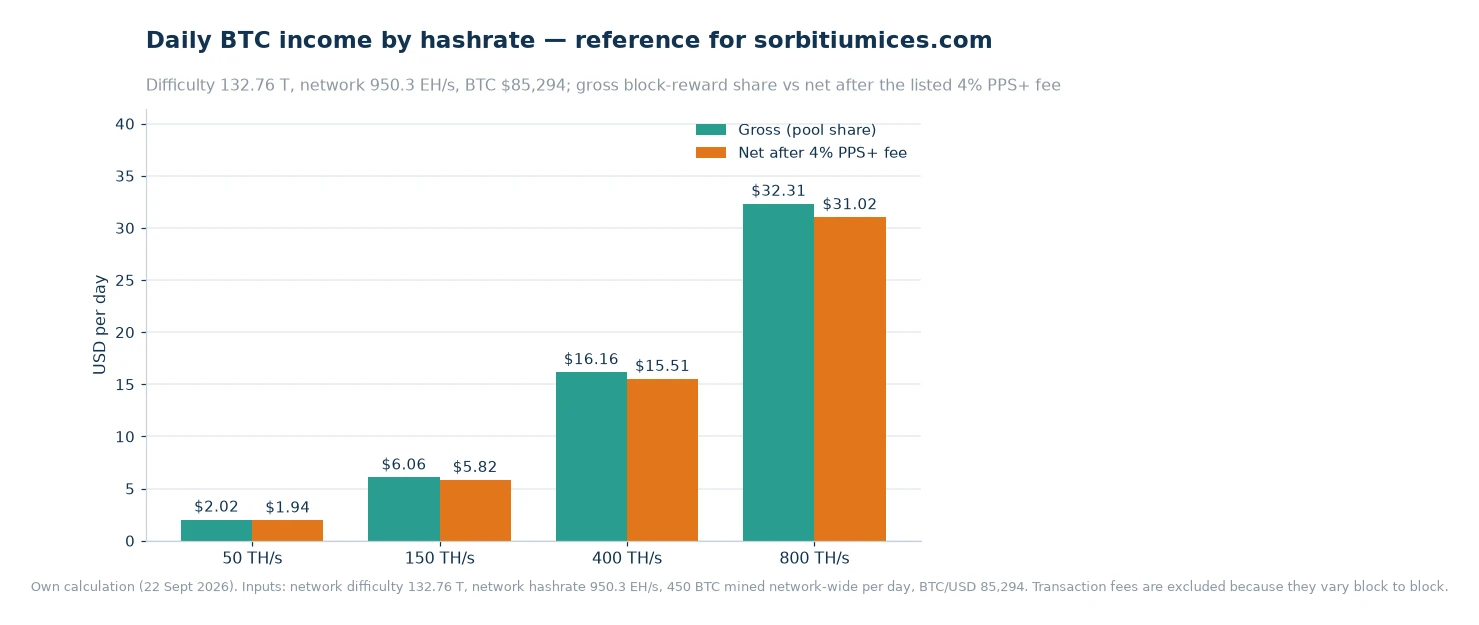
Growing from a single miner to a full rack changes three things at once: the load on the circuit, the heat in the room and the cost of every idle hour. At 20 J/TH, an 800 TH/s collection draws 16 kW, which is 384 kWh a day and about $23.04 at $0.06/kWh — against $32.31 of daily gross block-reward income at difficulty 132.76 T and $31.02 after the listed 4% fee.

Key takeaways
- Joules per terahash is the whole story: at 20 J/TH the fleet burns 0.48 kWh per TH/s per day, so 800 TH/s is 384 kWh daily.
- Breakeven electricity is $0.0841/kWh before fees and $0.0808/kWh after the listed 4% block-reward fee at 20 J/TH; at 15 J/TH those limits rise to $0.1122 and $0.1077.
- The marginal machine is worth less than the average one. Each extra 100 TH/s at 20 J/TH adds roughly $1 a day of margin on a $0.06 tariff.
- Infrastructure, not silicon, is what usually stops the build: 16 kW is about 67 A at 240 V and needs a dedicated feed.
Power draw decides everything else
Two fleets with identical hashrate can differ by a third in operating cost. At 20 J/TH, every terahash of capacity consumes 20 W continuously, which is 0.48 kWh over a day. Ten units of high-efficiency hardware at 15 J/TH consume 0.36 kWh per TH/s per day for the same work. Multiply by the fleet size and the tariff and the difference is real money, not a spec-sheet curiosity.
Income per terahash is fixed by the network, not by the hardware. At difficulty 132.76 T and a BTC price of $85,294, one TH/s produces about 0.0000004735 BTC a day, or $0.04, and about $0.0388 after the listed 4% fee on the PPS-settled block reward. Efficiency therefore only moves the cost side, which is exactly why the tariff and the joules-per-terahash figure must be read together before any purchase.
Put those two constants side by side and the breakeven is easy to state. At 20 J/TH a kilowatt-hour must cost less than $0.0841 for the block-reward income to cover power, or $0.0808 after the fee. At 15 J/TH the ceiling is $0.1122 before fees and $0.1077 after them. Above those tariffs, more hashrate at the same efficiency makes the loss larger rather than smaller.
What each capacity step looks like
The table below prices four sizes at a $0.06/kWh tariff and 20 J/TH. The last column is the number that decides whether the next step gets built: the contribution left after power, using income net of the listed 4% block-reward fee.
| Fleet size | Continuous draw | Energy per day | Power cost per day | Income after the listed 4% fee | Contribution |
|---|---|---|---|---|---|
| 50 TH/s | 1.0 kW | 24 kWh | $1.44 | $1.94 | $0.50 |
| 150 TH/s | 3.0 kW | 72 kWh | $4.32 | $5.82 | $1.50 |
| 400 TH/s | 8.0 kW | 192 kWh | $11.52 | $15.51 | $3.99 |
| 800 TH/s | 16.0 kW | 384 kWh | $23.04 | $31.02 | $7.98 |
Read the gaps between rows and a pattern appears. Going from 400 TH/s to 800 TH/s doubles the power bill by $11.52 a day and doubles the income by $15.51, leaving about $4 more contribution. The step is worth taking at this tariff and stops being worth taking somewhere between $0.06 and the $0.0808 ceiling, which is the point of doing the arithmetic before ordering hardware rather than after the first invoice.
Worked example
Take the 800 TH/s rack line by line. Step one, energy: 800 TH/s at 20 J/TH is 16,000 W, or 16 kW, sustained. Step two, daily consumption: 16 kW across 24 hours is 384 kWh. Step three, cost at a $0.06/kWh tariff: 384 multiplied by 0.06 is $23.04.
Step four, income: 800 TH/s multiplied by 0.0000004735 BTC per TH/s per day is about 0.00037882 BTC, or $32.31 gross. Step five, the fee: the listed 4% on the block-reward component is about $1.29, leaving $31.02. Step six, the result: $31.02 minus $23.04 leaves $7.98 a day of contribution at this tariff, and every extra terahash added at the same efficiency adds roughly a cent of that.
Step seven is the test that matters. Move the same rack to a site charging $0.10/kWh and the power line becomes $38.40 against $31.02 of fee-adjusted income — a negative contribution of about $7.38 a day. Nothing about the hardware changed. The location did, and that is the difference between a rack that pays for itself and one that quietly consumes its own output.
What breaks when a miner becomes a rack
The first break is electrical. A single miner usually fits an existing socket; a 16 kW rack draws roughly 67 A at 240 V and needs its own circuit, its own protection and a plan for the other loads in the room. If the site cannot supply that continuously, the fleet ends up running at reduced power, which converts directly into a lower hashrate and lower income.
The second break is thermal. Nearly all of the electricity becomes heat, so 16 kW of mining is 16 kW of heating with no thermostat. A rack that recirculates hot exhaust raises intake temperatures, and higher intake temperatures usually mean higher fan speeds and clocks pulled back. Airflow design is part of the capital cost, not an afterthought.
The third break is operational. One failed machine out of forty is a repair; the same failure in a two-unit setup is half the fleet. Spare parts, a labelled power map and a downtime log all start to matter at the same moment. If the site cannot be improved, a hosting arrangement is often the cheaper path: Mining Farms and the Mining Companies directory are worth reviewing against your own tariff math before committing capital to a new room.
The fourth break is monitoring. Individual miner dashboards do not add up to a fleet view, so the useful habit is to compare the pool's reported hashrate for the account with the local sum of machines. A gap between those two numbers is the earliest sign of throttling, a rejected worker or a network fault, and it is much cheaper to find in the first day than in the first invoice. Configure the account itself with the same discipline the hardware deserves, which is what a ViaBTC Mining Guide covers step by step for each supported coin.
Frequently asked questions
At what electricity price does 20 J/TH stop covering its own power?
At $0.0841/kWh the block-reward income and the power cost are level; after the listed 4% fee the limit is $0.0808/kWh. Beyond that tariff the rack loses money on power alone, before any other cost.
Does a rack really need a dedicated circuit?
At 16 kW the load is roughly 67 A at 240 V, which is beyond what a standard branch circuit carries continuously. Plan the feed, the protection and the cooling together with the hardware order, not after it.
Is PPS+ or PPLNS better when scaling up?
They differ in cadence and variance rather than in the work performed. PPS+ settles hourly at current difficulty with a listed 4% fee on the PPS-settled block reward, while PPLNS carries a listed 2% on both components and pays after 6 confirmations over the last 5 difficulty rounds.
Design the rack around the tariff
Start with the electricity price and the joules per terahash, not with the hashrate you want. Those two numbers set the ceiling on everything else: how many units the site can carry, whether the marginal machine adds contribution or drag, and whether the next step is a new circuit or a smaller fleet run properly. Then hold the rest of the plan to the same standard — measured hashrate, logged downtime, fees read from the schedule rather than remembered, and a breakeven figure you can restate from memory when a tariff changes.
Rate source: the listed ViaBTC schedule for PPS+ and PPLNS[1]. Energy figures assume 20 J/TH and 15 J/TH hardware as labelled, a kilowatt-hour price of $0.06 where stated, BTC difficulty 132.76 T and a BTC price of $85,294 — the difficulty and price were read from public chain data and market feeds on 22 Sept 2026. Figures are arithmetic on those inputs, change with difficulty, price and tariff, and are not a promise of earnings. read 22 Sept 2026.